EMT Practice Test

1. Question Content...


Question List

Question1: Your company's on-premises Apache Hadoop servers are approaching end-of-life, and IT has decided to migrate the cluster to Google Cloud Dataproc. A like-for-like migration of the cluster would require 50 TB of Google Persistent Disk per node. The CIO is concerned about the cost of using that much block storage. You want to minimize the storage cost of the migration. What should you do?

Question2: For the best possible performance, what is the recommended zone for your Compute Engine instance and Cloud Bigtable instance?

Question3: You want to optimize your queries for cost and performance. How should you structure your data?

Question4: Flowlogistic is rolling out their real-time inventory tracking system. The tracking devices will all send package-tracking messages, which will now go to a single Google Cloud Pub/Sub topic instead of the Apache Kafka cluster. A subscriber application will then process the messages for real-time reporting and store them in Google BigQuery for historical analysis. You want to ensure the package data can be analyzed over time.
Which approach should you take?

Question5: What is the recommended action to do in order to switch between SSD and HDD storage for your Google Cloud Bigtable instance?

Question6: Your company is running their first dynamic campaign, serving different offers by analyzing real-time data
during the holiday season. The data scientists are collecting terabytes of data that rapidly grows every
hour during their 30-day campaign. They are using Google Cloud Dataflow to preprocess the data and
collect the feature (signals) data that is needed for the machine learning model in Google Cloud Bigtable.
The team is observing suboptimal performance with reads and writes of their initial load of 10 TB of data.
They want to improve this performance while minimizing cost. What should they do?

Question7: Your company has hired a new data scientist who wants to perform complicated analyses across very large datasets stored in Google Cloud Storage and in a Cassandra cluster on Google Compute Engine. The scientist primarily wants to create labelled data sets for machine learning projects, along with some visualization tasks.
She reports that her laptop is not powerful enough to perform her tasks and it is slowing her down. You want to help her perform her tasks. What should you do?

Question8: You are using Google BigQuery as your data warehouse. Your users report that the following simple query is running very slowly, no matter when they run the query:
SELECT country, state, city FROM [myproject:mydataset.mytable] GROUP BY country
You check the query plan for the query and see the following output in the Read section of Stage:1:

What is the most likely cause of the delay for this query?

Question9: You have some data, which is shown in the graphic below. The two dimensions are X and Y, and the shade of each dot represents what class it is. You want to classify this data accurately using a linear algorithm. To do this you need to add a synthetic feature. What should the value of that feature be?

Question10: Your company produces 20,000 files every hour. Each data file is formatted as a comma separated values (CSV) file that is less than 4 KB. All files must be ingested on Google Cloud Platform before they can be processed. Your company site has a 200 ms latency to Google Cloud, and your Internet connection bandwidth is limited as 50 Mbps. You currently deploy a secure FTP (SFTP) server on a virtual machine in Google Compute Engine as the data ingestion point. A local SFTP client runs on a dedicated machine to transmit the CSV files as is. The goal is to make reports with data from the previous day available to the executives by 10:00 a.m. each day. This design is barely able to keep up with the current volume, even though the bandwidth utilization is rather low.
You are told that due to seasonality, your company expects the number of files to double for the next three months. Which two actions should you take? (choose two.)

Question11: You are designing a pipeline that publishes application events to a Pub/Sub topic. You need to aggregate events across hourly intervals before loading the results to BigQuery for analysis. Your solution must be scalable so it can process and load large volumes of events to BigQuery. What should you do?

Question12: You need to choose a database to store time series CPU and memory usage for millions of computers. You need to store this data in one-second interval samples. Analysts will be performing real-time, ad hoc analytics against the database. You want to avoid being charged for every query executed and ensure that the schema design will allow for future growth of the dataset. Which database and data model should you choose?

Question13: You designed a database for patient records as a pilot project to cover a few hundred patients in three clinics.
Your design used a single database table to represent all patients and their visits, and you used self-joins to generate reports. The server resource utilization was at 50%. Since then, the scope of the project has expanded.
The database must now store 100 times more patient records. You can no longer run the reports, because they either take too long or they encounter errors with insufficient compute resources. How should you adjust the database design?

Question14: You create an important report for your large team in Google Data Studio 360. The report uses Google
BigQuery as its data source. You notice that visualizations are not showing data that is less than 1 hour
old. What should you do?

Question15: An organization maintains a Google BigQuery dataset that contains tables with user-level datA. They want to expose aggregates of this data to other Google Cloud projects, while still controlling access to the user-level data. Additionally, they need to minimize their overall storage cost and ensure the analysis cost for other projects is assigned to those projects. What should they do?

Question16: Which Cloud Dataflow / Beam feature should you use to aggregate data in an unbounded data source every hour based on the time when the data entered the pipeline?

Question17: Which role must be assigned to a service account used by the virtual machines in a Dataproc cluster so they can execute jobs?

Question18: The marketing team at your organization provides regular updates of a segment of your customer dataset. The marketing team has given you a CSV with 1 million records that must be updated in BigQuery. When you use the UPDATE statement in BigQuery, you receive a quotaExceeded error. What should you do?

Question19: As your organization expands its usage of GCP, many teams have started to create their own projects. Projects are further multiplied to accommodate different stages of deployments and target audiences. Each project requires unique access control configurations. The central IT team needs to have access to all projects. Furthermore, data from Cloud Storage buckets and BigQuery datasets must be shared for use in other projects in an ad hoc way. You want to simplify access control management by minimizing the number of policies. Which two steps should you take? Choose 2 answers.

Question20: Which of these numbers are adjusted by a neural network as it learns from a training dataset (select 2 answers)?

Question21: You want to process payment transactions in a point-of-sale application that will run on Google Cloud Platform.
Your user base could grow exponentially, but you do not want to manage infrastructure scaling.
Which Google database service should you use?

Question22: You are building a new application that you need to collect data from in a scalable way. Data arrives continuously from the application throughout the day, and you expect to generate approximately 150 GB of JSON data per day by the end of the year. Your requirements are:
* Decoupling producer from consumer
* Space and cost-efficient storage of the raw ingested data, which is to be stored indefinitely
* Near real-time SQL query
* Maintain at least 2 years of historical data, which will be queried with SQL Which pipeline should you use to meet these requirements?

Question23: You have enabled the free integration between Firebase Analytics and Google BigQuery. Firebase now
automatically creates a new table daily in BigQuery in the format app_events_YYYYMMDD.You want to
query all of the tables for the past 30 days in legacy SQL. What should you do?

Question24: You work for a shipping company that uses handheld scanners to read shipping labels. Your company has strict data privacy standards that require scanners to only transmit recipients' personally identifiable information (PII) to analytics systems, which violates user privacy rules. You want to quickly build a scalable solution using cloud-native managed services to prevent exposure of PII to the analytics systems. What should you do?

Question25: You have some data, which is shown in the graphic below. The two dimensions are X and Y, and the shade of each dot represents what class it is. You want to classify this data accurately using a linear algorithm. To do this you need to add a synthetic feature. What should the value of that feature be?

Question26: Your organization has been collecting and analyzing data in Google BigQuery for 6 months. The majority of the data analyzed is placed in a time-partitioned table named events_partitioned. To reduce the cost of queries, your organization created a view called events, which queries only the last 14 days of data. The view is described in legacy SQL. Next month, existing applications will be connecting to BigQuery to read the events data via an ODBC connection. You need to ensure the applications can connect. Which two actions should you take? (Choose two.)

Question27: If you want to create a machine learning model that predicts the price of a particular stock based on its recent price history, what type of estimator should you use?

Question28: Your team is working on a binary classification problem. You have trained a support vector machine (SVM) classifier with default parameters, and received an area under the Curve (AUC) of 0.87 on the validation set.
You want to increase the AUC of the model. What should you do?

Question29: For the best possible performance, what is the recommended zone for your Compute Engine instance and Cloud Bigtable instance?

Question30: Which of the following are examples of hyperparameters? (Select 2 answers.)
Question31: Which role must be assigned to a service account used by the virtual machines in a Dataproc cluster so they can execute jobs?

Question32: You need ads data to serve Al models and historical data tor analytics longtail and outlier data points need to be identified You want to cleanse the data n near-reel time before running it through Al models What should you do?

Question33: Which of these numbers are adjusted by a neural network as it learns from a training dataset (select 2 answers)?

Question34: You are developing a software application using Google's Dataflow SDK, and want to use conditional, for loops and other complex programming structures to create a branching pipeline. Which component will be used for the data processing operation?

Question35: Your company is loading comma-separated values (CSV) files into Google BigQuery. The data is fully imported successfully; however, the imported data is not matching byte-to-byte to the source file. What is the most likely cause of this problem?

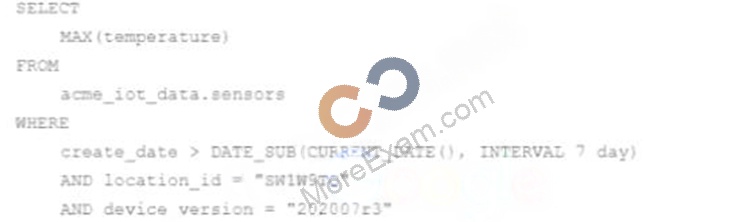
Question36: You are collecting loT sensor data from millions of devices across the world and storing the data in BigQuery. Your access pattern is based on recent data tittered by location_id and device_version with the following query:

You want to optimize your queries for cost and performance. How should you structure your data?

Question37: Which of the following is not true about Dataflow pipelines?

Question38: You've migrated a Hadoop job from an on-premises cluster to Dataproc and Good Storage. Your Spark job is a complex analytical workload fiat consists of many shuffling operations, and initial data are parquet toes (on average 200-400 MB size each) You see some degradation in performance after the migration to Dataproc so you'd like to optimize for it. Your organization is very cost-sensitive so you'd Idee to continue using Dataproc on preemptibles (with 2 non-preemptibles workers only) for this workload. What should you do?

Question39: You want to use a database of information about tissue samples to classify future tissue samples as either normal or mutated. You are evaluating an unsupervised anomaly detection method for classifying the tissue samples. Which two characteristic support this method? (Choose two.)

Question40: Your company uses a proprietary system to send inventory data every 6 hours to a data ingestion service
in the cloud. Transmitted data includes a payload of several fields and the timestamp of the transmission. If
there are any concerns about a transmission, the system re-transmits the data. How should you
deduplicate the data most efficiency?

Question41: Which of these are examples of a value in a sparse vector? (Select 2 answers.)

Question42: You're training a model to predict housing prices based on an available dataset with real estate properties.
Your plan is to train a fully connected neural net, and you've discovered that the dataset contains latitude and longtitude of the property. Real estate professionals have told you that the location of the property is highly influential on price, so you'd like to engineer a feature that incorporates this physical dependency.
What should you do?

Question43: You need to choose a database to store time series CPU and memory usage for millions of computers.
You need to store this data in one-second interval samples. Analysts will be performing real-time, ad hoc analytics against the database. You want to avoid being charged for every query executed and ensure that the schema design will allow for future growth of the dataset. Which database and data model should you choose?

Question44: You need to move 2 PB of historical data from an on-premises storage appliance to Cloud Storage within six months, and your outbound network capacity is constrained to 20 Mb/sec. How should you migrate this data to Cloud Storage?

Question45: An online retailer has built their current application on Google App Engine. A new initiative at the company mandates that they extend their application to allow their customers to transact directly via the application.
They need to manage their shopping transactions and analyze combined data from multiple datasets using a business intelligence (BI) tool. They want to use only a single database for this purpose. Which Google Cloud database should they choose?

Question46: You are deploying a new storage system for your mobile application, which is a media streaming service.
You decide the best fit is Google Cloud Datastore. You have entities with multiple properties, some of
which can take on multiple values. For example, in the entity 'Movie'the property 'actors'and the
property 'tags' have multiple values but the property 'date released' does not. A typical query
would ask for all movies with actor=<actorname>ordered by date_releasedor all movies with
tag=Comedyordered by date_released. How should you avoid a combinatorial explosion in the
number of indexes?

Question47: Each analytics team in your organization is running BigQuery jobs in their own projects. You want to enable each team to monitor slot usage within their projects. What should you do?

Question48: You are operating a Cloud Dataflow streaming pipeline. The pipeline aggregates events from a Cloud Pub/ Sub subscription source, within a window, and sinks the resulting aggregation to a Cloud Storage bucket.
The source has consistent throughput. You want to monitor an alert on behavior of the pipeline with Cloud Stackdriver to ensure that it is processing data. Which Stackdriver alerts should you create?

Question49: What are two methods that can be used to denormalize tables in BigQuery?

Question50: Which is not a valid reason for poor Cloud Bigtable performance?

Question51: You have an Apache Kafka Cluster on-prem with topics containing web application logs. You need to replicate the data to Google Cloud for analysis in BigQuery and Cloud Storage. The preferred replication method is mirroring to avoid deployment of Kafka Connect plugins.
What should you do?

Question52: You are integrating one of your internal IT applications and Google BigQuery, so users can query BigQuery from the application's interface. You do not want individual users to authenticate to BigQuery and you do not want to give them access to the dataset. You need to securely access BigQuery from your IT application.
What should you do?

Question53: You're using Bigtable for a real-time application, and you have a heavy load that is a mix of read and writes. You've recently identified an additional use case and need to perform hourly an analytical job to calculate certain statistics across the whole database. You need to ensure both the reliability of your production application as well as the analytical workload.
What should you do?

Question54: You are designing storage for 20 TB of text files as part of deploying a data pipeline on Google Cloud. Your input data is in CSV format. You want to minimize the cost of querying aggregate values for multiple users who will query the data in Cloud Storage with multiple engines. Which storage service and schema design should you use?

Question55: You have a query that filters a BigQuery table using a WHERE clause on timestamp and ID columns. By using bq query - -dry_run you learn that the query triggers a full scan of the table, even though the filter on timestamp and ID select a tiny fraction of the overall dat
a. You want to reduce the amount of data scanned by BigQuery with minimal changes to existing SQL queries. What should you do?

Question56: Your financial services company is moving to cloud technology and wants to store 50 TB of financial time-series data in the cloud. This data is updated frequently and new data will be streaming in all the time.
Your company also wants to move their existing Apache Hadoop jobs to the cloud to get insights into this data. Which product should they use to store the data?

Question57: You are designing a cloud-native historical data processing system to meet the following conditions:
* The data being analyzed is in CSV, Avro, and PDF formats and will be accessed by multiple analysis tools including Cloud Dataproc, BigQuery, and Compute Engine.
* A streaming data pipeline stores new data daily.
* Peformance is not a factor in the solution.
* The solution design should maximize availability.
How should you design data storage for this solution?

Question58: You are responsible for writing your company's ETL pipelines to run on an Apache Hadoop cluster. The pipeline will require some checkpointing and splitting pipelines. Which method should you use to write the pipelines?

Question59: Your neural network model is taking days to train. You want to increase the training speed. What can you do?

Question60: In order to securely transfer web traffic data from your computer's web browser to the Cloud Dataproc cluster you should use a(n) _____.

Question61: What are two methods that can be used to denormalize tables in BigQuery?

Question62: MJTelco Case Study
Company Overview
MJTelco is a startup that plans to build networks in rapidly growing, underserved markets around the world.
The company has patents for innovative optical communications hardware. Based on these patents, they can create many reliable, high-speed backbone links with inexpensive hardware.
Company Background
Founded by experienced telecom executives, MJTelco uses technologies originally developed to overcome communications challenges in space. Fundamental to their operation, they need to create a distributed data infrastructure that drives real-time analysis and incorporates machine learning to continuously optimize their topologies. Because their hardware is inexpensive, they plan to overdeploy the network allowing them to account for the impact of dynamic regional politics on location availability and cost.
Their management and operations teams are situated all around the globe creating many-to-many relationship between data consumers and provides in their system. After careful consideration, they decided public cloud is the perfect environment to support their needs.
Solution Concept
MJTelco is running a successful proof-of-concept (PoC) project in its labs. They have two primary needs:
* Scale and harden their PoC to support significantly more data flows generated when they ramp to more than 50,000 installations.
* Refine their machine-learning cycles to verify and improve the dynamic models they use to control topology definition.
MJTelco will also use three separate operating environments - development/test, staging, and production - to meet the needs of running experiments, deploying new features, and serving production customers.
Business Requirements
* Scale up their production environment with minimal cost, instantiating resources when and where needed in an unpredictable, distributed telecom user community.
* Ensure security of their proprietary data to protect their leading-edge machine learning and analysis.
* Provide reliable and timely access to data for analysis from distributed research workers
* Maintain isolated environments that support rapid iteration of their machine-learning models without affecting their customers.
Technical Requirements
Ensure secure and efficient transport and storage of telemetry data
Rapidly scale instances to support between 10,000 and 100,000 data providers with multiple flows each.
Allow analysis and presentation against data tables tracking up to 2 years of data storing approximately 100m records/day Support rapid iteration of monitoring infrastructure focused on awareness of data pipeline problems both in telemetry flows and in production learning cycles.
CEO Statement
Our business model relies on our patents, analytics and dynamic machine learning. Our inexpensive hardware is organized to be highly reliable, which gives us cost advantages. We need to quickly stabilize our large distributed data pipelines to meet our reliability and capacity commitments.
CTO Statement
Our public cloud services must operate as advertised. We need resources that scale and keep our data secure.
We also need environments in which our data scientists can carefully study and quickly adapt our models.
Because we rely on automation to process our data, we also need our development and test environments to work as we iterate.
CFO Statement
The project is too large for us to maintain the hardware and software required for the data and analysis. Also, we cannot afford to staff an operations team to monitor so many data feeds, so we will rely on automation and infrastructure. Google Cloud's machine learning will allow our quantitative researchers to work on our high-value problems instead of problems with our data pipelines.
MJTelco needs you to create a schema in Google Bigtable that will allow for the historical analysis of the last
2 years of records. Each record that comes in is sent every 15 minutes, and contains a unique identifier of the device and a data record. The most common query is for all the data for a given device for a given day. Which schema should you use?

Question63: You receive data files in CSV format monthly from a third party. You need to cleanse this data, but every third month the schema of the files changes. Your requirements for implementing these transformations include:
* Executing the transformations on a schedule
* Enabling non-developer analysts to modify transformations
* Providing a graphical tool for designing transformations
What should you do?

Question64: If you want to create a machine learning model that predicts the price of a particular stock based on its recent price history, what type of estimator should you use?

Question65: Your software uses a simple JSON format for all messages. These messages are published to Google Cloud Pub/Sub, then processed with Google Cloud Dataflow to create a real-time dashboard for the CFO.
During testing, you notice that some messages are missing in the dashboard. You check the logs, and all messages are being published to Cloud Pub/Sub successfully. What should you do next?

Question66: Which of the following IAM roles does your Compute Engine account require to be able to run pipeline jobs?

Question67: You are building a new application that you need to collect data from in a scalable way. Data arrives continuously from the application throughout the day, and you expect to generate approximately 150 GB of JSON data per day by the end of the year. Your requirements are:
Decoupling producer from consumer
Space and cost-efficient storage of the raw ingested data, which is to be stored indefinitely
Near real-time SQL query
Maintain at least 2 years of historical data, which will be queried with SQ
Which pipeline should you use to meet these requirements?

Question68: You work for a shipping company that has distribution centers where packages move on delivery lines to route them properly. The company wants to add cameras to the delivery lines to detect and track any visual damage to the packages in transit. You need to create a way to automate the detection of damaged packages and flag them for human review in real time while the packages are in transit. Which solution should you choose?

Question69: Case Study: 2,
Flowlogistic Case Study
Company Overview
Flowlogistic is a leading logistics and supply chain provider. They help businesses throughout the world manage their resources and transport them to their final destination. The company has grown rapidly, expanding their offerings to include rail, truck, aircraft, and oceanic shipping.
Company Background
The company started as a regional trucking company, and then expanded into other logistics market.
Because they have not updated their infrastructure, managing and tracking orders and shipments has become a bottleneck. To improve operations, Flowlogistic developed proprietary technology for tracking shipments in real time at the parcel level. However, they are unable to deploy it because their technology stack, based on Apache Kafka, cannot support the processing volume. In addition, Flowlogistic wants to further analyze their orders and shipments to determine how best to deploy their resources.
Solution Concept
Flowlogistic wants to implement two concepts using the cloud:
Use their proprietary technology in a real-time inventory-tracking system that indicates the location of their loads Perform analytics on all their orders and shipment logs, which contain both structured and unstructured data, to determine how best to deploy resources, which markets to expand info. They also want to use predictive analytics to learn earlier when a shipment will be delayed.
Existing Technical Environment
Flowlogistic architecture resides in a single data center:
Databases
8 physical servers in 2 clusters
SQL Server - user data, inventory, static data
3 physical servers
Cassandra - metadata, tracking messages
10 Kafka servers - tracking message aggregation and batch insert
Application servers - customer front end, middleware for order/customs 60 virtual machines across 20 physical servers Tomcat - Java services Nginx - static content Batch servers Storage appliances iSCSI for virtual machine (VM) hosts Fibre Channel storage area network (FC SAN) ?SQL server storage Network-attached storage (NAS) image storage, logs, backups Apache Hadoop /Spark servers Core Data Lake Data analysis workloads
20 miscellaneous servers
Jenkins, monitoring, bastion hosts,
Business Requirements
Build a reliable and reproducible environment with scaled panty of production. Aggregate data in a centralized Data Lake for analysis Use historical data to perform predictive analytics on future shipments Accurately track every shipment worldwide using proprietary technology Improve business agility and speed of innovation through rapid provisioning of new resources Analyze and optimize architecture for performance in the cloud Migrate fully to the cloud if all other requirements are met Technical Requirements Handle both streaming and batch data Migrate existing Hadoop workloads Ensure architecture is scalable and elastic to meet the changing demands of the company.
Use managed services whenever possible
Encrypt data flight and at rest
Connect a VPN between the production data center and cloud environment SEO Statement We have grown so quickly that our inability to upgrade our infrastructure is really hampering further growth and efficiency. We are efficient at moving shipments around the world, but we are inefficient at moving data around.
We need to organize our information so we can more easily understand where our customers are and what they are shipping.
CTO Statement
IT has never been a priority for us, so as our data has grown, we have not invested enough in our technology. I have a good staff to manage IT, but they are so busy managing our infrastructure that I cannot get them to do the things that really matter, such as organizing our data, building the analytics, and figuring out how to implement the CFO' s tracking technology.
CFO Statement
Part of our competitive advantage is that we penalize ourselves for late shipments and deliveries. Knowing where out shipments are at all times has a direct correlation to our bottom line and profitability.
Additionally, I don't want to commit capital to building out a server environment.
Flowlogistic wants to use Google BigQuery as their primary analysis system, but they still have Apache Hadoop and Spark workloads that they cannot move to BigQuery. Flowlogistic does not know how to store the data that is common to both workloads. What should they do?

Question70: Which of the following are examples of hyperparameters? (Select 2 answers.)

Question71: You have a data pipeline with a Cloud Dataflow job that aggregates and writes time series metrics to Cloud Bigtable. This data feeds a dashboard used by thousands of users across the organization. You need to support additional concurrent users and reduce the amount of time required to write the data. Which two actions should you take? (Choose two.)

Question72: Which methods can be used to reduce the number of rows processed by BigQuery?

Question73: Your company currently runs a large on-premises cluster using Spark Hive and Hadoop Distributed File System (HDFS) in a colocation facility. The duster is designed to support peak usage on the system, however, many jobs are batch n nature, and usage of the cluster fluctuates quite dramatically.
Your company is eager to move to the cloud to reduce the overhead associated with on-premises infrastructure and maintenance and to benefit from the cost savings. They are also hoping to modernize their existing infrastructure to use more servers offerings m order to take advantage of the cloud Because of the tuning of their contract renewal with the colocation facility they have only 2 months for their initial migration How should you recommend they approach thee upcoming migration strategy so they can maximize their cost savings in the cloud will still executing the migration in time?

Question74: Given the record streams MJTelco is interested in ingesting per day, they are concerned about the cost of Google BigQuery increasing. MJTelco asks you to provide a design solution. They require a single large data table called tracking_table. Additionally, they want to minimize the cost of daily queries while performing fine-grained analysis of each day's events. They also want to use streaming ingestion. What should you do?

Question75: MJTelco Case Study
Company Overview
MJTelco is a startup that plans to build networks in rapidly growing, underserved markets around the world. The company has patents for innovative optical communications hardware. Based on these patents, they can create many reliable, high-speed backbone links with inexpensive hardware.
Company Background
Founded by experienced telecom executives, MJTelco uses technologies originally developed to overcome communications challenges in space. Fundamental to their operation, they need to create a distributed data infrastructure that drives real-time analysis and incorporates machine learning to continuously optimize their topologies. Because their hardware is inexpensive, they plan to overdeploy the network allowing them to account for the impact of dynamic regional politics on location availability and cost.
Their management and operations teams are situated all around the globe creating many-to-many relationship between data consumers and provides in their system. After careful consideration, they decided public cloud is the perfect environment to support their needs.
Solution Concept
MJTelco is running a successful proof-of-concept (PoC) project in its labs. They have two primary needs:
Scale and harden their PoC to support significantly more data flows generated when they ramp to more

than 50,000 installations.
Refine their machine-learning cycles to verify and improve the dynamic models they use to control

topology definition.
MJTelco will also use three separate operating environments - development/test, staging, and production
- to meet the needs of running experiments, deploying new features, and serving production customers.
Business Requirements
Scale up their production environment with minimal cost, instantiating resources when and where

needed in an unpredictable, distributed telecom user community.
Ensure security of their proprietary data to protect their leading-edge machine learning and analysis.

Provide reliable and timely access to data for analysis from distributed research workers

Maintain isolated environments that support rapid iteration of their machine-learning models without

affecting their customers.
Technical Requirements
Ensure secure and efficient transport and storage of telemetry data

Rapidly scale instances to support between 10,000 and 100,000 data providers with multiple flows

each.
Allow analysis and presentation against data tables tracking up to 2 years of data storing approximately

100m records/day
Support rapid iteration of monitoring infrastructure focused on awareness of data pipeline problems

both in telemetry flows and in production learning cycles.
CEO Statement
Our business model relies on our patents, analytics and dynamic machine learning. Our inexpensive hardware is organized to be highly reliable, which gives us cost advantages. We need to quickly stabilize our large distributed data pipelines to meet our reliability and capacity commitments.
CTO Statement
Our public cloud services must operate as advertised. We need resources that scale and keep our data secure. We also need environments in which our data scientists can carefully study and quickly adapt our models. Because we rely on automation to process our data, we also need our development and test environments to work as we iterate.
CFO Statement
The project is too large for us to maintain the hardware and software required for the data and analysis.
Also, we cannot afford to staff an operations team to monitor so many data feeds, so we will rely on automation and infrastructure. Google Cloud's machine learning will allow our quantitative researchers to work on our high-value problems instead of problems with our data pipelines.
MJTelco needs you to create a schema in Google Bigtable that will allow for the historical analysis of the last 2 years of records. Each record that comes in is sent every 15 minutes, and contains a unique identifier of the device and a data record. The most common query is for all the data for a given device for a given day. Which schema should you use?

Question76: You need to move 2 PB of historical data from an on-premises storage appliance to Cloud Storage within six months, and your outbound network capacity is constrained to 20 Mb/sec. How should you migrate this data to Cloud Storage?

Question77: Your company has hired a new data scientist who wants to perform complicated analyses across very large datasets stored in Google Cloud Storage and in a Cassandra cluster on Google Compute Engine. The scientist primarily wants to create labelled data sets for machine learning projects, along with some visualization tasks.
She reports that her laptop is not powerful enough to perform her tasks and it is slowing her down. You want to help her perform her tasks. What should you do?

Question78: MJTelco Case Study
Company Overview
MJTelco is a startup that plans to build networks in rapidly growing, underserved markets around the world.
The company has patents for innovative optical communications hardware. Based on these patents, they can create many reliable, high-speed backbone links with inexpensive hardware.
Company Background
Founded by experienced telecom executives, MJTelco uses technologies originally developed to overcome communications challenges in space. Fundamental to their operation, they need to create a distributed data infrastructure that drives real-time analysis and incorporates machine learning to continuously optimize their topologies. Because their hardware is inexpensive, they plan to overdeploy the network allowing them to account for the impact of dynamic regional politics on location availability and cost.
Their management and operations teams are situated all around the globe creating many-to-many relationship between data consumers and provides in their system. After careful consideration, they decided public cloud is the perfect environment to support their needs.
Solution Concept
MJTelco is running a successful proof-of-concept (PoC) project in its labs. They have two primary needs:
* Scale and harden their PoC to support significantly more data flows generated when they ramp to more than 50,000 installations.
* Refine their machine-learning cycles to verify and improve the dynamic models they use to control topology definition.
MJTelco will also use three separate operating environments - development/test, staging, and production - to meet the needs of running experiments, deploying new features, and serving production customers.
Business Requirements
* Scale up their production environment with minimal cost, instantiating resources when and where needed in an unpredictable, distributed telecom user community.
* Ensure security of their proprietary data to protect their leading-edge machine learning and analysis.
* Provide reliable and timely access to data for analysis from distributed research workers
* Maintain isolated environments that support rapid iteration of their machine-learning models without affecting their customers.
Technical Requirements
* Ensure secure and efficient transport and storage of telemetry data
* Rapidly scale instances to support between 10,000 and 100,000 data providers with multiple flows each.
* Allow analysis and presentation against data tables tracking up to 2 years of data storing approximately
100m records/day
* Support rapid iteration of monitoring infrastructure focused on awareness of data pipeline problems both in telemetry flows and in production learning cycles.
CEO Statement
Our business model relies on our patents, analytics and dynamic machine learning. Our inexpensive hardware is organized to be highly reliable, which gives us cost advantages. We need to quickly stabilize our large distributed data pipelines to meet our reliability and capacity commitments.
CTO Statement
Our public cloud services must operate as advertised. We need resources that scale and keep our data secure. We also need environments in which our data scientists can carefully study and quickly adapt our models. Because we rely on automation to process our data, we also need our development and test environments to work as we iterate.
CFO Statement
The project is too large for us to maintain the hardware and software required for the data and analysis. Also, we cannot afford to staff an operations team to monitor so many data feeds, so we will rely on automation and infrastructure. Google Cloud's machine learning will allow our quantitative researchers to work on our high- value problems instead of problems with our data pipelines.
MJTelco's Google Cloud Dataflow pipeline is now ready to start receiving data from the 50,000 installations.
You want to allow Cloud Dataflow to scale its compute power up as required. Which Cloud Dataflow pipeline configuration setting should you update?

Question79: Case Study 1 - Flowlogistic
Company Overview
Flowlogistic is a leading logistics and supply chain provider. They help businesses throughout the world manage their resources and transport them to their final destination. The company has grown rapidly, expanding their offerings to include rail, truck, aircraft, and oceanic shipping.
Company Background
The company started as a regional trucking company, and then expanded into other logistics market.
Because they have not updated their infrastructure, managing and tracking orders and shipments has become a bottleneck. To improve operations, Flowlogistic developed proprietary technology for tracking shipments in real time at the parcel level. However, they are unable to deploy it because their technology stack, based on Apache Kafka, cannot support the processing volume. In addition, Flowlogistic wants to further analyze their orders and shipments to determine how best to deploy their resources.
Solution Concept
Flowlogistic wants to implement two concepts using the cloud:
* Use their proprietary technology in a real-time inventory-tracking system that indicates the location of their loads
* Perform analytics on all their orders and shipment logs, which contain both structured and unstructured data, to determine how best to deploy resources, which markets to expand info. They also want to use predictive analytics to learn earlier when a shipment will be delayed.
Existing Technical Environment
Flowlogistic architecture resides in a single data center:
* Databases
8 physical servers in 2 clusters
- SQL Server - user data, inventory, static data
3 physical servers
- Cassandra - metadata, tracking messages
10 Kafka servers - tracking message aggregation and batch insert
* Application servers - customer front end, middleware for order/customs
60 virtual machines across 20 physical servers
- Tomcat - Java services
- Nginx - static content
- Batch servers
* Storage appliances
- iSCSI for virtual machine (VM) hosts
- Fibre Channel storage area network (FC SAN) - SQL server storage
- Network-attached storage (NAS) image storage, logs, backups
* 10 Apache Hadoop /Spark servers
- Core Data Lake
- Data analysis workloads
* 20 miscellaneous servers
- Jenkins, monitoring, bastion hosts,
Business Requirements
* Build a reliable and reproducible environment with scaled panty of production.
* Aggregate data in a centralized Data Lake for analysis
* Use historical data to perform predictive analytics on future shipments
* Accurately track every shipment worldwide using proprietary technology
* Improve business agility and speed of innovation through rapid provisioning of new resources
* Analyze and optimize architecture for performance in the cloud
* Migrate fully to the cloud if all other requirements are met
Technical Requirements
* Handle both streaming and batch data
* Migrate existing Hadoop workloads
* Ensure architecture is scalable and elastic to meet the changing demands of the company.
* Use managed services whenever possible
* Encrypt data flight and at rest
* Connect a VPN between the production data center and cloud environment SEO Statement We have grown so quickly that our inability to upgrade our infrastructure is really hampering further growth and efficiency. We are efficient at moving shipments around the world, but we are inefficient at moving data around.
We need to organize our information so we can more easily understand where our customers are and what they are shipping.
CTO Statement
IT has never been a priority for us, so as our data has grown, we have not invested enough in our technology. I have a good staff to manage IT, but they are so busy managing our infrastructure that I cannot get them to do the things that really matter, such as organizing our data, building the analytics, and figuring out how to implement the CFO' s tracking technology.
CFO Statement
Part of our competitive advantage is that we penalize ourselves for late shipments and deliveries. Knowing where out shipments are at all times has a direct correlation to our bottom line and profitability. Additionally, I don't want to commit capital to building out a server environment.
Flowlogistic wants to use Google BigQuery as their primary analysis system, but they still have Apache Hadoop and Spark workloads that they cannot move to BigQuery. Flowlogistic does not know how to store the data that is common to both workloads. What should they do?

Question80: Your infrastructure includes a set of YouTube channels. You have been tasked with creating a process for
sending the YouTube channel data to Google Cloud for analysis. You want to design a solution that allows
your world-wide marketing teams to perform ANSI SQL and other types of analysis on up-to-date YouTube
channels log data. How should you set up the log data transfer into Google Cloud?

Question81: You've migrated a Hadoop job from an on-prem cluster to dataproc and GCS. Your Spark job is a complicated analytical workload that consists of many shuffing operations and initial data are parquet files (on average 200-400 MB size each). You see some degradation in performance after the migration to Dataproc, so you'd like to optimize for it. You need to keep in mind that your organization is very cost- sensitive, so you'd like to continue using Dataproc on preemptibles (with 2 non-preemptible workers only) for this workload.
What should you do?

Question82: You want to use Google Stackdriver Logging to monitor Google BigQuery usage. You need an instant notification to be sent to your monitoring tool when new data is appended to a certain table using an insert job, but you do not want to receive notifications for other tables. What should you do?

Question83: You use BigQuery as your centralized analytics platform. New data is loaded every day, and an ETL pipeline modifies the original data and prepares it for the final users. This ETL pipeline is regularly modified and can generate errors, but sometimes the errors are detected only after 2 weeks. You need to provide a method to recover from these errors, and your backups should be optimized for storage costs. How should you organize your data in BigQuery and store your backups?

Question84: You want to use a BigQuery table as a data sink. In which writing mode(s) can you use BigQuery as a sink?

Question85: Your neural network model is taking days to train. You want to increase the training speed. What can you do?

Question86: You are developing an application on Google Cloud that will automatically generate subject labels for users' blog posts. You are under competitive pressure to add this feature quickly, and you have no additional developer resources. No one on your team has experience with machine learning. What should you do?

Question87: Cloud Dataproc charges you only for what you really use with _____ billing.

Question88: You use BigQuery as your centralized analytics platform. New data is loaded every day, and an ETL pipeline modifies the original data and prepares it for the final users. This ETL pipeline is regularly modified and can generate errors, but sometimes the errors are detected only after 2 weeks. You need to provide a method to recover from these errors, and your backups should be optimized for storage costs. How should you organize your data in BigQuery and store your backups?

Question89: You are designing a basket abandonment system for an ecommerce company. The system will send a message to a user based on these rules:
No interaction by the user on the site for 1 hour

Has added more than $30 worth of products to the basket

Has not completed a transaction

You use Google Cloud Dataflow to process the data and decide if a message should be sent. How should you design the pipeline?

Question90: Your company built a TensorFlow neural-network model with a large number of neurons and layers. The model fits well for the training data. However, when tested against new data, it performs poorly. What method can you employ to address this?

Question91: You are working on a linear regression model on BigQuery ML to predict a customer's likelihood of purchasing your company's products. Your model uses a city name variable as a key predictive component in order to train and serve the model your data must be organized in columns. You want to prepare your data using the least amount of coding while maintaining the predictable variables. What should you do?

Question92: You are developing an application on Google Cloud that will automatically generate subject labels for users' blog posts. You are under competitive pressure to add this feature quickly, and you have no additional developer resources. No one on your team has experience with machine learning. What should you do?

Question93: You need to compose visualization for operations teams with the following requirements:
* Telemetry must include data from all 50,000 installations for the most recent 6 weeks (sampling once every minute)
* The report must not be more than 3 hours delayed from live data.
* The actionable report should only show suboptimal links.
* Most suboptimal links should be sorted to the top.
* Suboptimal links can be grouped and filtered by regional geography.
* User response time to load the report must be <5 seconds.
You create a data source to store the last 6 weeks of data, and create visualizations that allow viewers to see multiple date ranges, distinct geographic regions, and unique installation types. You always show the latest data without any changes to your visualizations. You want to avoid creating and updating new visualizations each month. What should you do?

Question94: Case Study 1 - Flowlogistic
Company Overview
Flowlogistic is a leading logistics and supply chain provider. They help businesses throughout the world manage their resources and transport them to their final destination. The company has grown rapidly, expanding their offerings to include rail, truck, aircraft, and oceanic shipping.
Company Background
The company started as a regional trucking company, and then expanded into other logistics market.
Because they have not updated their infrastructure, managing and tracking orders and shipments has become a bottleneck. To improve operations, Flowlogistic developed proprietary technology for tracking shipments in real time at the parcel level. However, they are unable to deploy it because their technology stack, based on Apache Kafka, cannot support the processing volume. In addition, Flowlogistic wants to further analyze their orders and shipments to determine how best to deploy their resources.
Solution Concept
Flowlogistic wants to implement two concepts using the cloud:
* Use their proprietary technology in a real-time inventory-tracking system that indicates the location of their loads
* Perform analytics on all their orders and shipment logs, which contain both structured and unstructured data, to determine how best to deploy resources, which markets to expand info. They also want to use predictive analytics to learn earlier when a shipment will be delayed.
Existing Technical Environment
Flowlogistic architecture resides in a single data center:
* Databases
8 physical servers in 2 clusters
- SQL Server - user data, inventory, static data
3 physical servers
- Cassandra - metadata, tracking messages
10 Kafka servers - tracking message aggregation and batch insert
* Application servers - customer front end, middleware for order/customs
60 virtual machines across 20 physical servers
- Tomcat - Java services
- Nginx - static content
- Batch servers
* Storage appliances
- iSCSI for virtual machine (VM) hosts
- Fibre Channel storage area network (FC SAN) - SQL server storage
- Network-attached storage (NAS) image storage, logs, backups
* 10 Apache Hadoop /Spark servers
- Core Data Lake
- Data analysis workloads
* 20 miscellaneous servers
- Jenkins, monitoring, bastion hosts,
Business Requirements
* Build a reliable and reproducible environment with scaled panty of production.
* Aggregate data in a centralized Data Lake for analysis
* Use historical data to perform predictive analytics on future shipments
* Accurately track every shipment worldwide using proprietary technology
* Improve business agility and speed of innovation through rapid provisioning of new resources
* Analyze and optimize architecture for performance in the cloud
* Migrate fully to the cloud if all other requirements are met
Technical Requirements
* Handle both streaming and batch data
* Migrate existing Hadoop workloads
* Ensure architecture is scalable and elastic to meet the changing demands of the company.
* Use managed services whenever possible
* Encrypt data flight and at rest
* Connect a VPN between the production data center and cloud environment SEO Statement We have grown so quickly that our inability to upgrade our infrastructure is really hampering further growth and efficiency. We are efficient at moving shipments around the world, but we are inefficient at moving data around.
We need to organize our information so we can more easily understand where our customers are and what they are shipping.
CTO Statement
IT has never been a priority for us, so as our data has grown, we have not invested enough in our technology. I have a good staff to manage IT, but they are so busy managing our infrastructure that I cannot get them to do the things that really matter, such as organizing our data, building the analytics, and figuring out how to implement the CFO' s tracking technology.
CFO Statement
Part of our competitive advantage is that we penalize ourselves for late shipments and deliveries. Knowing where out shipments are at all times has a direct correlation to our bottom line and profitability. Additionally, I don't want to commit capital to building out a server environment.
Flowlogistic's CEO wants to gain rapid insight into their customer base so his sales team can be better informed in the field. This team is not very technical, so they've purchased a visualization tool to simplify the creation of BigQuery reports. However, they've been overwhelmed by all the data in the table, and are spending a lot of money on queries trying to find the data they need. You want to solve their problem in the most cost-effective way. What should you do?

Question95: Your neural network model is taking days to train. You want to increase the training speed. What can you
do?

Question96: Your company is performing data preprocessing for a learning algorithm in Google Cloud Dataflow. Numerous data logs are being are being generated during this step, and the team wants to analyze them. Due to the dynamic nature of the campaign, the data is growing exponentially every hour.
The data scientists have written the following code to read the data for a new key features in the logs.
BigQueryIO.Read
.named("ReadLogData")
.from("clouddataflow-readonly:samples.log_data")
You want to improve the performance of this data read. What should you do?

Question97: You have a data stored in BigQuery. The data in the BigQuery dataset must be highly available. You need to define a storage, backup, and recovery strategy of this data that minimizes cost. How should you configure the BigQuery table?

Question98: MJTelco is building a custom interface to share dat
a. They have these requirements:
They need to do aggregations over their petabyte-scale datasets.
They need to scan specific time range rows with a very fast response time (milliseconds).
Which combination of Google Cloud Platform products should you recommend?

Question99: Your analytics team wants to build a simple statistical model to determine which customers are most likely to work with your company again, based on a few different metrics. They want to run the model on Apache Spark, using data housed in Google Cloud Storage, and you have recommended using Google Cloud Dataproc to execute this job. Testing has shown that this workload can run in approximately 30 minutes on a 15-node cluster, outputting the results into Google BigQuery. The plan is to run this workload weekly. How should you optimize the cluster for cost?

Question100: You are building a model to make clothing recommendations. You know a user's fashion pis likely to change over time, so you build a data pipeline to stream new data back to the model as it becomes available. How should you use this data to train the model?

Question101: You are responsible for writing your company's ETL pipelines to run on an Apache Hadoop cluster. The pipeline will require some checkpointing and splitting pipelines. Which method should you use to write the pipelines?

Question102: Flowlogistic is rolling out their real-time inventory tracking system. The tracking devices will all send package-tracking messages, which will now go to a single Google Cloud Pub/Sub topic instead of the Apache Kafka cluster. A subscriber application will then process the messages for real-time reporting and store them in Google BigQuery for historical analysis. You want to ensure the package data can be analyzed over time.
Which approach should you take?

Question103: You need to set access to BigQuery for different departments within your company. Your solution should comply with the following requirements:
* Each department should have access only to their data.
* Each department will have one or more leads who need to be able to create and update tables and provide them to their team.
* Each department has data analysts who need to be able to query but not modify data.
How should you set access to the data in BigQuery?

Question104: You are using Google BigQuery as your data warehouse. Your users report that the following simple query is running very slowly, no matter when they run the query:
SELECT country, state, city FROM [myproject:mydataset.mytable] GROUP BY country You check the query plan for the query and see the following output in the Read section of Stage:1:

What is the most likely cause of the delay for this query?

Question105: Which Cloud Dataflow / Beam feature should you use to aggregate data in an unbounded data source every hour based on the time when the data entered the pipeline?

Question106: You have data pipelines running on BigQuery, Cloud Dataflow, and Cloud Dataproc. You need to perform health checks and monitor their behavior, and then notify the team managing the pipelines if they fail. You also need to be able to work across multiple projects. Your preference is to use managed products of features of the platform. What should you do?

Question107: You have developed three data processing jobs. One executes a Cloud Dataflow pipeline that transforms data uploaded to Cloud Storage and writes results to BigQuery. The second ingests data from on- premises servers and uploads it to Cloud Storage. The third is a Cloud Dataflow pipeline that gets information from third-party data providers and uploads the information to Cloud Storage. You need to be able to schedule and monitor the execution of these three workflows and manually execute them when needed. What should you do?

Question108: You operate a logistics company, and you want to improve event delivery reliability for vehicle-based sensors. You operate small data centers around the world to capture these events, but leased lines that provide connectivity from your event collection infrastructure to your event processing infrastructure are unreliable, with unpredictable latency. You want to address this issue in the most cost-effective way. What should you do?

Question109: You need to create a data pipeline that copies time-series transaction data so that it can be queried from within BigQuery by your data science team for analysis. Every hour, thousands of transactions are updated with a new status. The size of the intitial dataset is 1.5 PB, and it will grow by 3 TB per day. The data is heavily structured, and your data science team will build machine learning models based on this data. You want to maximize performance and usability for your data science team. Which two strategies should you adopt? (Choose two.)

Question110: You use a dataset in BigQuery for analysis. You want to provide third-party companies with access to the same dataset. You need to keep the costs of data sharing low and ensure that the data is current. Which solution should you choose?

Question111: You have Google Cloud Dataflow streaming pipeline running with a Google Cloud Pub/Sub subscription as the source. You need to make an update to the code that will make the new Cloud Dataflow pipeline incompatible with the current version. You do not want to lose any data when making this update. What should you do?

Question112: Your team is working on a binary classification problem. You have trained a support vector machine (SVM) classifier with default parameters, and received an area under the Curve (AUC) of 0.87 on the validation set. You want to increase the AUC of the model. What should you do?

Question113: If you're running a performance test that depends upon Cloud Bigtable, all the choices except one below are recommended steps. Which is NOT a recommended step to follow?

Question114: Your company is implementing a data warehouse using BigQuery and you have been tasked with designing the data model You move your on-premises sales data warehouse with a star data schema to BigQuery but notice performance issues when querying the data of the past 30 days Based on Google's recommended practices, what should you do to speed up the query without increasing storage costs?

Question115: You are developing an application that uses a recommendation engine on Google Cloud. Your solution should display new videos to customers based on past views. Your solution needs to generate labels for the entities in videos that the customer has viewed. Your design must be able to provide very fast filtering suggestions based on data from other customer preferences on several TB of data. What should you do?

Question116: You work for a large bank that operates in locations throughout North America. You are setting up a data storage system that will handle bank account transactions. You require ACID compliance and the ability to access data with SQL. Which solution is appropriate?

Question117: Your software uses a simple JSON format for all messages. These messages are published to Google Cloud Pub/Sub, then processed with Google Cloud Dataflow to create a real-time dashboard for the CFO. During testing, you notice that some messages are missing in the dashboard. You check the logs, and all messages are being published to Cloud Pub/Sub successfully. What should you do next?

Question118: You want to use Google Stackdriver Logging to monitor Google BigQuery usage. You need an instant notification to be sent to your monitoring tool when new data is appended to a certain table using an insert job, but you do not want to receive notifications for other tables. What should you do?

Question119: Your company built a TensorFlow neutral-network model with a large number of neurons and layers. The model fits well for the training data. However, when tested against new data, it performs poorly. What method can you employ to address this?

Question120: You currently have a single on-premises Kafka cluster in a data center in the us-east region that is responsible for ingesting messages from IoT devices globally. Because large parts of globe have poor internet connectivity, messages sometimes batch at the edge, come in all at once, and cause a spike in load on your Kafka cluster.
This is becoming difficult to manage and prohibitively expensive. What is the Google-recommended cloud native architecture for this scenario?

Question121: Your team is responsible for developing and maintaining ETLs in your company. One of your Dataflow jobs is failing because of some errors in the input data, and you need to improve reliability of the pipeline (incl. being able to reprocess all failing data).
What should you do?

Question122: If you want to create a machine learning model that predicts the price of a particular stock based on its recent price history, what type of estimator should you use?

Question123: The CUSTOM tier for Cloud Machine Learning Engine allows you to specify the number of which types of cluster nodes?

Question124: You launched a new gaming app almost three years ago. You have been uploading log files from the previous day to a separate Google BigQuery table with the table name format LOGS_yyyymmdd. You have been using table wildcard functions to generate daily and monthly reports for all time ranges. Recently, you discovered that some queries that cover long date ranges are exceeding the limit of 1,000 tables and failing. How can you resolve this issue?

Question125: You are developing a software application using Google's Dataflow SDK, and want to use conditional, for loops and other complex programming structures to create a branching pipeline. Which component will be used for the data processing operation?

Question126: You are managing a Cloud Dataproc cluster. You need to make a job run faster while minimizing costs, without losing work in progress on your clusters. What should you do?

Question127: You are designing storage for 20 TB of text files as part of deploying a data pipeline on Google Cloud. Your input data is in CSV format. You want to minimize the cost of querying aggregate values for multiple users who will query the data in Cloud Storage with multiple engines. Which storage service and schema design should you use?

Question128: You are deploying a new storage system for your mobile application, which is a media streaming service. You decide the best fit is Google Cloud Datastore. You have entities with multiple properties, some of which can take on multiple values. For example, in the entity 'Movie' the property 'actors' and the property 'tags' have multiple values but the property 'date released' does not. A typical query would ask for all movies with actor=<actorname> ordered by date_released or all movies with tag=Comedy ordered by date_released. How should you avoid a combinatorial explosion in the number of indexes?

Question129: Which role must be assigned to a service account used by the virtual machines in a Dataproc cluster so they can execute jobs?

Question130: Which of the following are feature engineering techniques? (Select 2 answers)

Question131: You have developed three data processing jobs. One executes a Cloud Dataflow pipeline that transforms data uploaded to Cloud Storage and writes results to BigQuery. The second ingests data from on- premises servers and uploads it to Cloud Storage. The third is a Cloud Dataflow pipeline that gets information from third-party data providers and uploads the information to Cloud Storage. You need to be able to schedule and monitor the execution of these three workflows and manually execute them when needed. What should you do?

Question132: Flowlogistic's management has determined that the current Apache Kafka servers cannot handle the data volume for their real-time inventory tracking system. You need to build a new system on Google Cloud Platform (GCP) that will feed the proprietary tracking software. The system must be able to ingest data from a variety of global sources, process and query in real-time, and store the data reliably. Which combination of GCP products should you choose?